Published: 2025-12-10 · Otokum Rent a Car · Atakum / Samsun
AI and Sustainability in the Automotive Industry
The automotive industry is undergoing a multilayered transformation shaped by artificial intelligence, Industry 4.0 technologies, and sustainability mandates.This article synthesizes the provided research to explain how autonomous mobility, smart manufacturing, and circular economy models evolve together from an Otokum perspective.
Key Findings
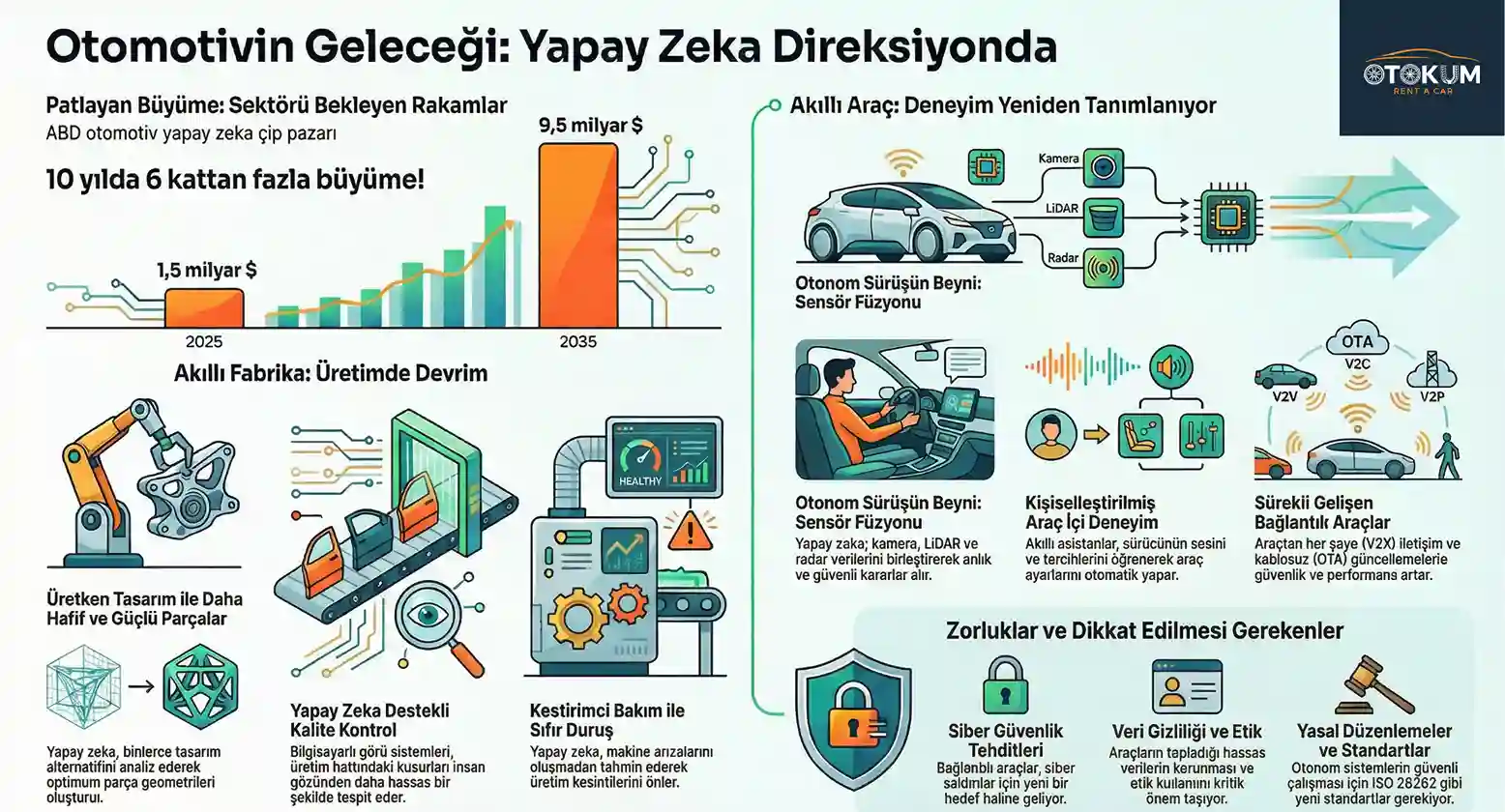
- Rise of autonomous driving: Players like Waymo, Tesla, and Aurora rely on deep learning, sensor fusion, and billions of driven miles to advance ADAS and autonomous fleets. - Smart manufacturing revolution: AI vision reaches up to 98.3 % defect detection accuracy, predictive maintenance cuts unplanned downtime by 35.7 %, and assembly lines gain 42.3 % productivity. - Sustainability and circular economy: Policies such as Malaysia’s ELV program aim to lift recycled component ratios and relieve environmental pressure. - Electrification: Battery chemistry, BMS software, and power electronics leverage AI to boost efficiency and battery health.AI in Autonomous Vehicles and ADAS
Core Technologies and Applications
- Perception and sensor fusion: LiDAR, radar, cameras, GPS, and ultrasonic inputs merge into 3D environment models, balancing each sensor’s blind spots. - Decision making and trajectory planning: Deep and reinforcement learning anticipate traffic actors and orchestrate acceleration, braking, and lane changes in real time. - Object detection: CNN - based models classify pedestrians, vehicles, traffic signs, and lane markings with high fidelity. - Use cases: Waymo operates Level 4 robotaxis with 250k weekly rides and 20B + training miles, Tesla’s Dojo Edge speeds up FSD inference by 10x, and Aurora hauled 7k loads across 2M miles in 2024 with zero incidents.Technical, Ethical, and Legal Challenges
- Reliability and cyber security: Adversarial inputs, spoofed sensors, and malicious interference demand hardened architectures. - Ethical dilemmas and transparency: Trolley - problem scenarios and black - box decisioning slow public trust; privacy concerns remain acute. - Regulatory uncertainty: Fragmented state or national rules leave liability(OEM, software vendor, vehicle owner) unresolved.Leading Companies and Market Outlook
- Google(Waymo), Tesla, Apple, BMW, Audi, GM, Ford, NVIDIA, Intel, and Microsoft headline the ecosystem. - The global autonomous vehicle market is projected to reach USD 325.9B by 2030, with automotive AI chip revenues accelerating alongside ADAS and connected - vehicle demand.AI in Automotive Manufacturing and Supply Chains
Industry 4.0 and Smart Factories
- Artificial intelligence: Analyzes production data, supervises quality, predicts maintenance, and optimizes resource use. - IIoT networks: Stream continuous machine telemetry to feed predictive models. - Digital twins: Provide virtual replicas for simulation, stress testing, and rapid optimization. - Cobots and AR / VR instructions: Cut operator errors and shrink training cycles through guided workflows.Production Applications
- Quality control: Computer vision flags defects with up to 98.3 % accuracy. - Predictive maintenance: Vibration and temperature analytics reduce unplanned downtime by 35.7 % while extending asset life. - Assembly and robotics: AI - guided robots raise throughput by 42.3 % and cut error rates by 28.9 %. - Generative design and mistake proofing: Light - guided systems, smart glasses, and mixed reality standardize complex assemblies.Supply - Chain Optimization
- Transformer - based demand models digest 1, 250 + variables to deliver 95.3 % near - term forecast accuracy. - Better signal quality trims inventory costs by 34.7 % and improves supply - chain resilience by 52.3 %. - Federated AI and smart contracts safeguard data privacy while enabling trustworthy collaboration.Sustainability and End - of - Life Vehicle Management
- Malaysia’s 2025 ELV policy targets lower carbon emissions, better fuel economy, and higher recovery rates through a stakeholder - led circular framework. - Service centers, used - parts dealers, remanufacturers, and policymakers coordinate to unlock environmental and economic value from ELV recycling.Electric Vehicles and Enabling Technologies
Architectures and Components
- BEV, HEV, FCEV: All - electric, hybrid, and fuel - cell drivetrains serve distinct mission profiles. - Battery technology: Li - ion dominates thanks to high energy density, while solid - state research accelerates. - Battery management systems: Monitor state - of - charge and state - of - health to keep charging cycles safe. - Power electronics: AC - DC, DC - DC, and inverter stages orchestrate energy transfers efficiently.AI’s Contribution
- Optimizes hybrid and electric powertrains for longer range and lower emissions. - Enhances BMS algorithms to predict battery health and prevent unexpected failures. - Applies predictive maintenance analytics to motors, packs, and power electronics for smarter service planning.Conclusion
Automotive leaders now treat AI not merely as a productivity lever but as a cornerstone of competitive advantage, customer experience, and sustainable growth.Success depends on confronting technical, ethical, and regulatory hurdles with transparent governance and a people - centric integration strategy.Bookings and information, 24/7: +90 533 657 02 91